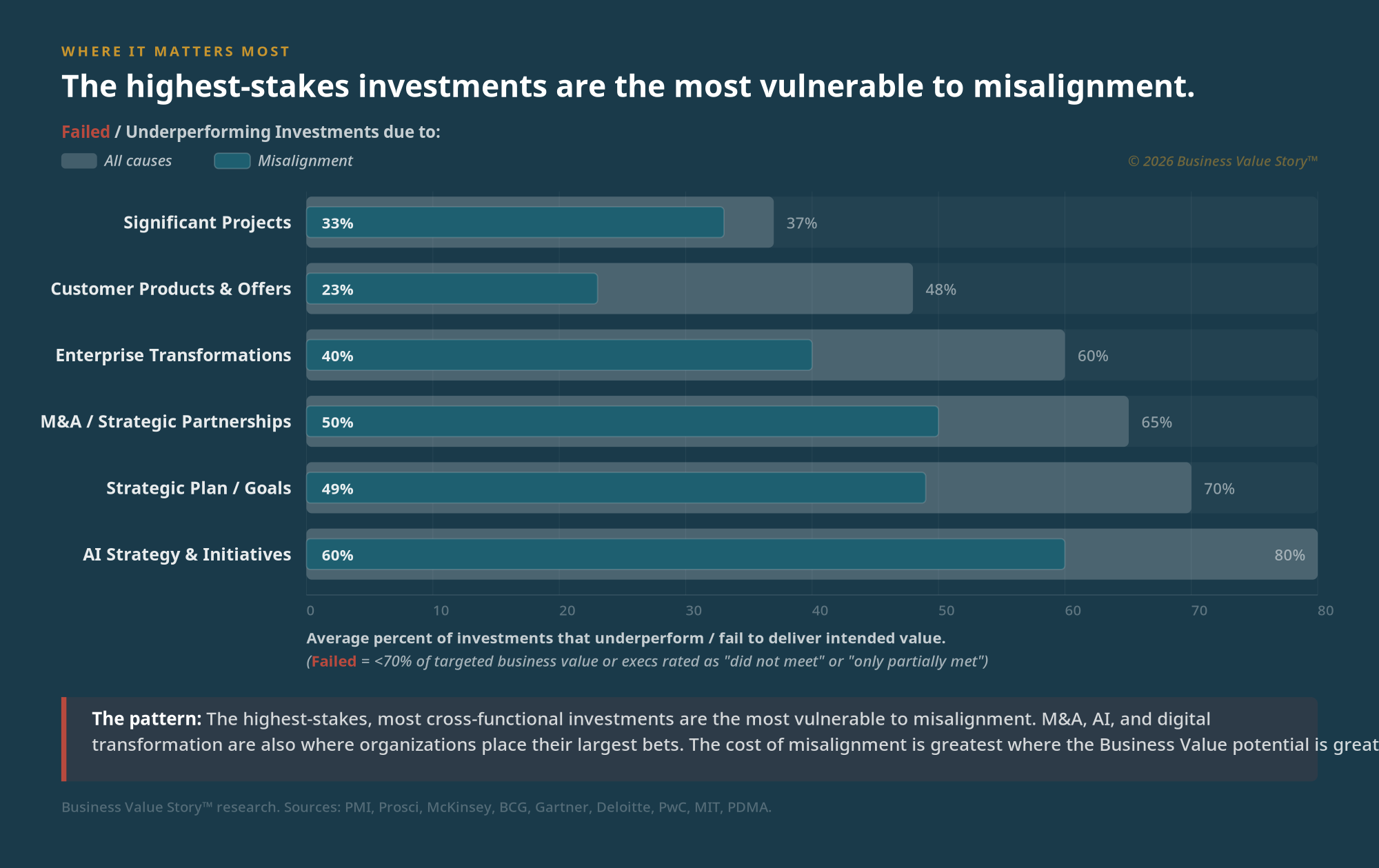
Every organization makes investments that define where it is going. Strategic plans, transformations, new market strategies, technology commitments. These investments are significant in scale and cross-functional in scope.
They are also where the gap between the return that was planned and the return that is possible is largest.
The more functions involved, the more Business Value potential exists, and the greater the cost when the people shaping and delivering the investment are not aligned to it.
80% of organizations struggle to report material earnings impact from AI.
Organizations are investing heavily in AI, but 80% struggle to report material earnings impact. The pattern is consistent: each function pursues AI through its own lens, Operations toward automation, Marketing toward personalization, IT toward infrastructure, creating fragmented adoption that reinforces silos rather than compounding value.
The Business Value the organization should expect from its AI investment, capturing new markets, strengthening competitive positioning, accelerating time to market, improving customer outcomes, is not typically defined before the technology decisions begin.
Resources are spread across competing pilots with no shared view of which investments matter most. Initiatives get funded, stall, and restart as priorities shift.
The organization spends heavily on AI and struggles to explain what it achieved.
What gets identified is shaped by who is in the room and what they can see from their own perspective.
Strategic plans set direction, allocate resources, and prioritize investments. The leaders in the room bring real knowledge about the Business Value those investments should create. But what gets identified is shaped by who is in the room and what they can see from their own perspective.
The Business Value that lives between their perspectives is rarely surfaced, strengthening competitive positioning, optimizing working capital, or building workforce capability.
When those investments move to execution without a shared picture of the full Business Value they should deliver, functions interpret success differently.
The result is duplicated effort, conflicting priorities, and resources directed toward a fraction of the return that was possible.
The broader the transformation, the greater the opportunity and the greater the cost when the people delivering it are not aligned.
Enterprise transformations are the largest, most complex investments most organizations make. They touch every function, every process, and every part of the operating model. Yet the Business Value the transformation should create is typically defined the same way smaller investments are: each function contributes its own view.
The result is a plan that captures the value each function can see, but misses the value the transformation could create across them. A transformation that strengthens customer profitability, accelerates time to market, and builds partner performance simultaneously creates far more value than one optimized function by function.
And when functions move into execution without a shared definition of success, the cost compounds. Decisions conflict, timelines stretch, and the Business Value that was planned for quietly fails to materialize across hundreds of small misalignments.
Organizations pursuing digital transformation have captured only 31% of expected revenue lift and 25% of expected cost savings.
According to McKinsey, organizations pursuing digital transformation have captured only 31% of expected revenue lift and 25% of expected cost savings. The investment is typically framed around technology: platforms, systems, data, infrastructure. IT leads the architecture. Operations leads the process redesign. Finance builds the business case around the cost and efficiency gains they can quantify.
But the Business Value the transformation could create for the organization, accelerating innovation, improving customer profitability, or strengthening market positioning, often sits outside the scope of any single function’s planning.
When the Business Value is not defined before the technology decisions begin, the organization builds against an incomplete picture. And when functions are not aligned to that picture during execution, the gap between expected and actual return widens with every decision made in isolation.
A growth investment can create Business Value well beyond the revenue line.
When an organization invests in growth, whether entering a new market, expanding an existing one, or launching a new customer segment, the strategy is typically built by Sales, Marketing, and Product. The business case focuses on revenue targets, customer acquisition, and market share.
But a growth investment can create Business Value well beyond the revenue line, strengthening brand reputation, building partner ecosystems, or developing workforce capabilities that serve the organization long after the market is entered.
When that broader value is not visible, resources are directed toward the revenue case alone and the organization pursues a fraction of the return that was possible. And when the functions responsible for delivering that growth are not aligned to the same definition of success, execution fragments. Sales, Marketing, Operations, and Product each optimize for their own version of the goal.
Almost 70% of mergers fail to achieve the revenue synergies expected at the time of the deal.
According to McKinsey, almost 70% of mergers fail to achieve the revenue synergies expected at the time of the deal. The pattern is consistent: each organization defines its own value, due diligence quantifies the overlap, and the deal is approved on the basis of projected synergies.
But those synergies represent the Business Value that lives between two organizations, between their customers, their operations, their capabilities, their markets. When that value is not comprehensively identified and defined before the deal closes, integration teams are left designing for a fraction of the potential.
And the cost of misalignment during integration is enormous. Two organizations, two cultures, two sets of assumptions about what success looks like. Without a shared definition, the very synergies that justified the deal quietly fail to materialize.
When leaders from both organizations define the full Business Value together before integration begins, they not only scope a more complete return but start building the cross-organizational alignment that makes integration work.
75 to 85 percent of new products fail financially, not because they are poorly built, but because they don’t address what the customer is actually trying to achieve.
Harvard Business School professor Clayton Christensen estimated that 75 to 85 percent of new products fail financially, not because the products are poorly built, but because they don’t address what the customer is actually trying to achieve.
Product Management understands the capability. Marketing understands the message. Sales understands the customer’s pain. Finance understands the investment threshold. Each can carry real knowledge about what the customer values, but that knowledge often lives in separate conversations and is rarely assembled into one picture.
When a product goes to market without that full picture, it can end up competing on features rather than on the Business Value it creates for the customer’s organization. And when the functions responsible for designing, pricing, marketing, and selling the product are not aligned to the same definition of customer value, the offering can reach the market slower, positioned inconsistently, and priced against how it works rather than what it delivers.
The Business Value of workforce transformation extends well beyond talent, but few organizations see the impact that broadly.
Workforce transformation is typically led by HR and scoped around talent acquisition, skills development, organizational design, and culture. These are critical capabilities. But the Business Value that a workforce transformation can create for the organization, accelerating time to market, strengthening customer relationships, enabling innovation, often extends well beyond HR’s scope.
The leaders across the organization who depend on workforce capability are rarely part of defining what the investment should deliver. When the full Business Value is not visible, the workforce investment is designed for what HR can see from its own perspective.
And when the functions who depend on the outcomes are not aligned to the same picture, adoption stalls. New capabilities get built that don’t connect to what the business actually needs. The investment delivers against HR’s definition of success, not the organization’s.
Every investment on this list carries more Business Value potential than the planning process typically surfaces, and a greater cost of misalignment than most organizations realize. When the full potential is visible and the people delivering it are aligned, the organization gets a far greater return. By design.
Questions about Business Value? A specific investment or initiative on your mind? We’d love to hear your thoughts and ideas ...
Let’s Talk Business ValueThe broader the investment, the greater the cost when the people delivering it are not aligned.